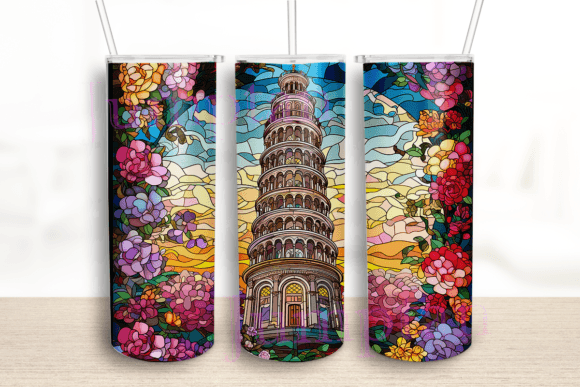
Stained Glass Leaning Tower Tumbler
A Designer’s First Glance: Charm with a Slight Quirk
Opening the ZIP for Stained Glass Leaning Tower Tumbler, I immediately noticed two crisp 300 DPI PNGs — one straight, one tapered — both sized 9.3” x 8.2”. As an embroidery designer who evaluates hundreds of graphics yearly, my first instinct wasn’t to admire the tower’s tilt or stained glass motif alone, but to ask: *Where does this live in real life?* It’s not a generic skyline or abstract shape — it’s playful, architectural, and quietly nostalgic. The stained glass treatment suggests light, color, and craftsmanship, while the leaning angle adds whimsy without tipping into cartoonishness. That balance matters — especially when you’re stitching it onto something meant to be held, gifted, or sold.
This Isn’t Just a Graphic — It’s a Conversation Starter
I recently used Stained Glass Leaning Tower Tumbler as the centerpiece for a custom embroidered canvas tote bag destined for a boutique gift shop in Florence, KY. Why that combo? Because the design’s vertical proportion and mid-scale detail translate beautifully to tote fronts — large enough to read at arm’s length, detailed enough to reward closer inspection. Customers paused. They pointed. One asked, “Is that handmade?” — which, coming from someone browsing $75 artisan goods, is high praise. That’s the quiet power of this design: it reads as intentional, not clip-art. It belongs on sweatshirt backs, pillow covers for travel-themed nurseries, and even aprons for small-batch coffee roasters leaning into Italian heritage.
Where It Shines (and Where It Needs Care)
Stained Glass Leaning Tower Tumbler performs best when treated like a focal-point machine embroidery design — not filler. On medium-weight cotton canvas (think tea towels or tote bags), the tapered version wraps elegantly around curved surfaces, while the straight version anchors cleanly on flat panels like sweatshirt backs or baby onesies. Its line weight and internal segmentation suggest confident satin stitch borders and thoughtful fill stitch zones — ideal for embroiderers who value clarity over clutter.
But here’s what I watched closely: the narrow leaded-glass segments near the tower’s crown. On stretchy fabric like jersey or thin knits, those fine divisions risk blurring unless stabilized properly. Likewise, dark fabric demands careful thread color selection — a deep cobalt or burgundy works better than black for contrast, preserving the stained glass illusion. And if you’re planning Stained Glass Leaning Tower Tumbler for caps or curved seams, test the tapered PNG first. Not all “tapered” files behave the same across hoop sizes or digitizing software — always mock up digitally before hooping.
Real-World Fit Across Craft Business Use Cases
- Custom apparel: Strong on crewneck sweatshirts and relaxed-fit tees — avoids the chest pocket zone and sits cleanly above waistbands.
- Baby embroidery: Works well on receiving blankets or nursery pillow covers, but avoid placing it near hems or elastic where distortion could compress the stained glass lines.
- Embroidered patch: Highly adaptable — the clean outer silhouette and internal contrast make it ideal for sew-on or iron-on patches on denim jackets or backpacks.
- Holiday & gift embroidery: Surprisingly versatile for Easter baskets (as a “tower of treats” motif) or wedding favors (pair with monogrammed linen napkins).
- Etsy seller & small shop product: Standout in listings with strong printable mockups — the stained glass aesthetic photographs beautifully in natural light, boosting perceived handmade value.
Design Integrity Meets Commercial Practicality
What sets Stained Glass Leaning Tower Tumbler apart from generic graphics isn’t just its theme — it’s how thoughtfully scaled and composed it is for translation into thread. The 9.3” x 8.2” dimensions aren’t arbitrary; they straddle the sweet spot between visibility and versatility. Too small, and the stained glass effect dissolves. Too large, and it overwhelms most standard hoops and garment placements. As a craft business owner, I appreciate that — it means less resizing, fewer stitch-density surprises, and more predictable finished product quality.
That predictability builds customer trust. When someone orders a personalized gift featuring Stained Glass Leaning Tower Tumbler, they’re not just buying a tumbler graphic — they’re buying charm, craftsmanship, and a subtle nod to travel, art, or lighthearted tradition. That emotional resonance lifts perceived value, especially in competitive spaces like Etsy or local craft fairs.
Practical Embroidery Designer Notes Before You Stitch
- Test Stained Glass Leaning Tower Tumbler on scrap fabric matching your final project’s weight and stretch — especially if using textured weaves or blends.
- Check thread color contrast early: lay out your palette against both light and dark backgrounds before digitizing or ordering pre-digitized files.
- Review stitch density visually — high-fill areas (like glass panes) may require tear-away or cut-away stabilizer depending on fabric stability.
- Confirm hoop size compatibility — while the PNG gives you flexibility, your embroidery file’s actual stitch area must fit within your machine’s max hoop.
- Inspect small details at 200% zoom — look for potential running stitch gaps or overly tight satin edges that could snag during wear or washing.
- Always test in black-and-white mockups — if the design loses legibility without color, reconsider thread choices or placement.
- Verify licensing terms before selling finished items or bundling Stained Glass Leaning Tower Tumbler into digital embroidery bundles — this is a Graphics listing, not a pre-digitized embroidery file.
Final Thought: A Design That Earns Its Place
Stained Glass Leaning Tower Tumbler doesn’t shout. It leans in — gently, confidently, with color and character. It’s the kind of Crafts asset that elevates a simple tote into a keepsake, or turns a plain sweatshirt into a conversation piece. For embroidery designers and creative entrepreneurs, it’s not just another download — it’s a reliable, mood-lifting design asset that supports authenticity, intentionality, and real-world usability. Just remember: let the stained glass shine, stabilize wisely, and always stitch like someone will hold it, cherish it, and ask, “Where did you find this?”