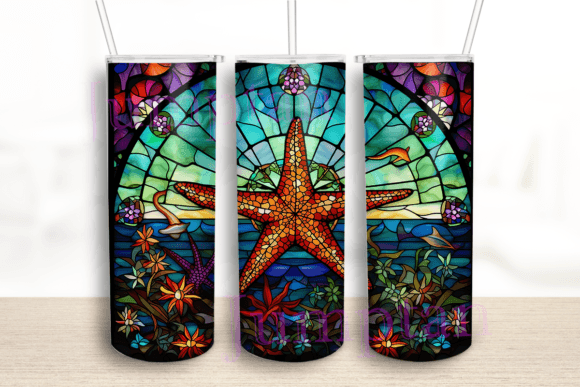
Stained Glass Starfish Tumbler
A Designer’s First Look: Light, Delicate, and Full of Quiet Charm
When I opened the Stained Glass Starfish Tumbler files—two crisp 300 DPI PNGs, one straight and one tapered—I didn’t see just another beach-themed graphic. I saw a design that breathes like handmade glass: translucent edges, subtle gradients, and a starfish shape that balances organic flow with clean geometry. It’s not loud or cartoonish—it leans into quiet sophistication. That makes it ideal for crafters who want to elevate everyday items without shouting. Think embroidered linen tea towels for a coastal boutique, minimalist sweatshirt fronts for a small shop, or delicate nursery pillow covers where softness matters more than flash.
Where This Design Truly Shines (and Where It Needs Care)
I tested the Stained Glass Starfish Tumbler as part of a custom embroidered tote bag project—linen-cotton blend, medium weight, finished with French seams and leather handles. The starfish sat centered on the front panel, sized to 7.5”. On fabric, its stained-glass illusion translated beautifully: the tapered version followed the gentle curve of the tote’s body, while the straight version worked cleanly on flat panels like aprons or pillow covers. Customers noticed it immediately—not because it was bold, but because it felt intentional and hand-selected.
It works especially well for:
- Personalized gifts — baby onesies (use lightweight stabilizer), holiday kitchen towels, wedding guest towels with monogrammed corners
- Small business merchandise — boutique-branded sweatshirts, artisan coffee shop totes, coastal-themed Etsy listings
- Digital embroidery file prep — the high-res PNGs hold up well in vector conversion tools and printable mockups for client approvals
- Nursery and gender-neutral decor — pairs naturally with muted palettes, organic cotton, and minimal stitching density
But here’s what I watched closely: fine detail doesn’t always survive dense fill stitch or tight curves. On a curved cap front? The tapered version helped—but only if hooped precisely and stitched with reduced density. On stretchy knit baby bodysuits? I skipped satin-stitch borders entirely and used running stitch outlines instead. And on dark fabrics? The design’s subtlety means contrast becomes critical—test thread colors early, especially in the “glass” zones where lightness reads as transparency.
Real Embroidery Decisions You’ll Make Before Stitching
This isn’t a plug-and-play machine embroidery design. It’s a graphics asset—meaning you’ll convert it yourself, or work with a digitizer. So before you commit to a batch of embroidered patches or Etsy listings, ask these questions:
- What’s your hoop size? At 9.3” x 8.2”, this design pushes mid-range hoops. If you’re using a 5x7” frame, scaling down will soften edges and compress fine lines—especially around the starfish’s outer rays.
- What stabilizer are you pairing it with? For smooth fabrics like poplin or twill: medium cutaway. For textured linens or terrycloth towels: tear-away + topping. Skip the topping on baby items unless you’re confident it’ll fully dissolve.
- How dense is your fill stitch? Too dense, and the stained-glass effect flattens into solid color. Too loose, and the “glass” gaps disappear. Aim for 18–22% density in transparent zones—and confirm with a test run on scrap fabric.
- Is your thread palette supporting the mood? Avoid neon or metallics unless intentionally contrasting. Soft heathers, seafoam greens, pale corals, and warm ivories honor the design’s natural voice.
Why Craft Business Owners Should Pause Here
If you sell on Etsy or at local craft fairs, first impressions drive trust—and the Stained Glass Starfish Tumbler builds that quietly. It reads as thoughtful, not mass-produced. When stitched onto a handmade ceramic mug sleeve or an organic cotton tea towel, it feels like part of a curated collection—not a clipart afterthought. That perception lifts perceived value, supports premium pricing, and encourages repeat buyers who recognize your consistent aesthetic.
But remember: this is a Graphics product, not a pre-digitized embroidery file. That means licensing responsibility falls on you. Before listing finished embroidered products—or selling converted files—verify usage rights. Some designers allow commercial embroidery use; others restrict resale of digital assets entirely. Don’t assume. Check the seller’s terms, or ask directly.
Design Notes You’ll Want to Keep Handy
As someone who’s digitized hundreds of craft designs, here’s my shortlist for making the Stained Glass Starfish Tumbler work reliably:
- Always stitch a test piece—on the exact fabric and stabilizer you’ll use in production
- Review small details at 200% zoom before digitizing: those thin “lead lines” between glass sections must translate clearly in satin stitch
- Check black-and-white mockups—they reveal contrast issues faster than color previews
- Compare light vs. dark backgrounds—what reads as delicate on ivory may vanish on navy without adjusted underlay or thread choice
- Confirm compatibility with your workflow—if you rely on auto-digitizing tools, test how well they interpret gradient transitions and tapered edges
- Think beyond apparel—this design shines on embroidered patches for backpacks, applique elements on quilt blocks, or even laser-cut vinyl stencils for fabric painting
Final Thought: A Design That Earns Its Place
The Stained Glass Starfish Tumbler won’t dominate a busy market table—but it will draw people in, slow them down, and make them pause to touch the texture of the stitch. It’s the kind of design that fits seamlessly into a cohesive craft business identity: calm, considered, and quietly confident. Whether you’re embroidering a single personalized gift or building a line of coastal-inspired home goods, this graphic earns its space by doing one thing exceptionally well: inviting attention without demanding it. Just remember—it’s a starting point, not a finish line. Your skill, fabric choices, and intentionality bring it to life. And that’s where the real craft begins.